The Last F(l)ight Home Released - Ten Levels, Ten Bosses and a Very Long Way Home
A brand new game 1.0 - September 2026 is now officially released: “The Last F(l)ight Home”, an arcade side-scrolling space shooter for iPhone, iPad, Mac, Apple TV and Apple Watch.
You sit in the cockpit of a lone fighter with a very long way still to go. You fly right, the world scrolls past, and none of it wants to let you through: canyon walls closing in, gun turrets dug into the rock, crawlers working along the floor and the ceiling, and squadrons coming at you out of the distance.
A Corridor That Does Not Want You Through It
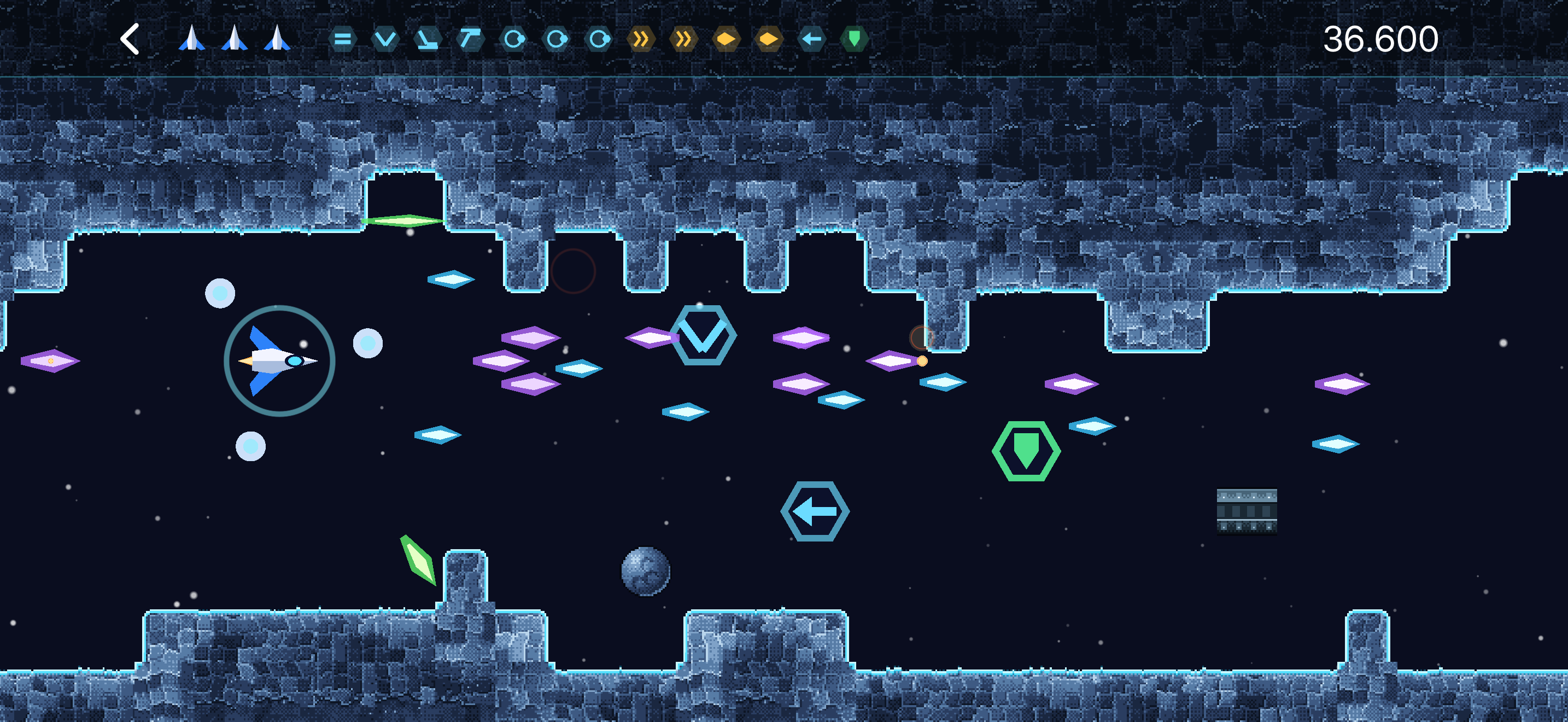
Every level is a hand-built canyon, written out as a tile map and flown from left to right. The landscape is not scenery: rock, floor and ceiling are solid, the corridor narrows and steps without warning, and a wall met at speed ends the ship as surely as a bolt does. Between the walls stand the things that were put there on purpose — metal pillars and steel beams, drifting boulders, crystals, mines, spikes grown out of the surface, and rubble low enough to fly over if you commit to it.
Turrets are bolted into the rock on the floor and on the ceiling, their cannons turning to follow you, some of them riding a rail along the wall they sit on. An obstacle is meant to be a decision rather than a wall of noise, so they are spaced out: never two hazards crowded together, never a turret sharing a column with anything else. The answer to a turret takes the whole width of the corridor to fly.
A Gun That Grows With the Run
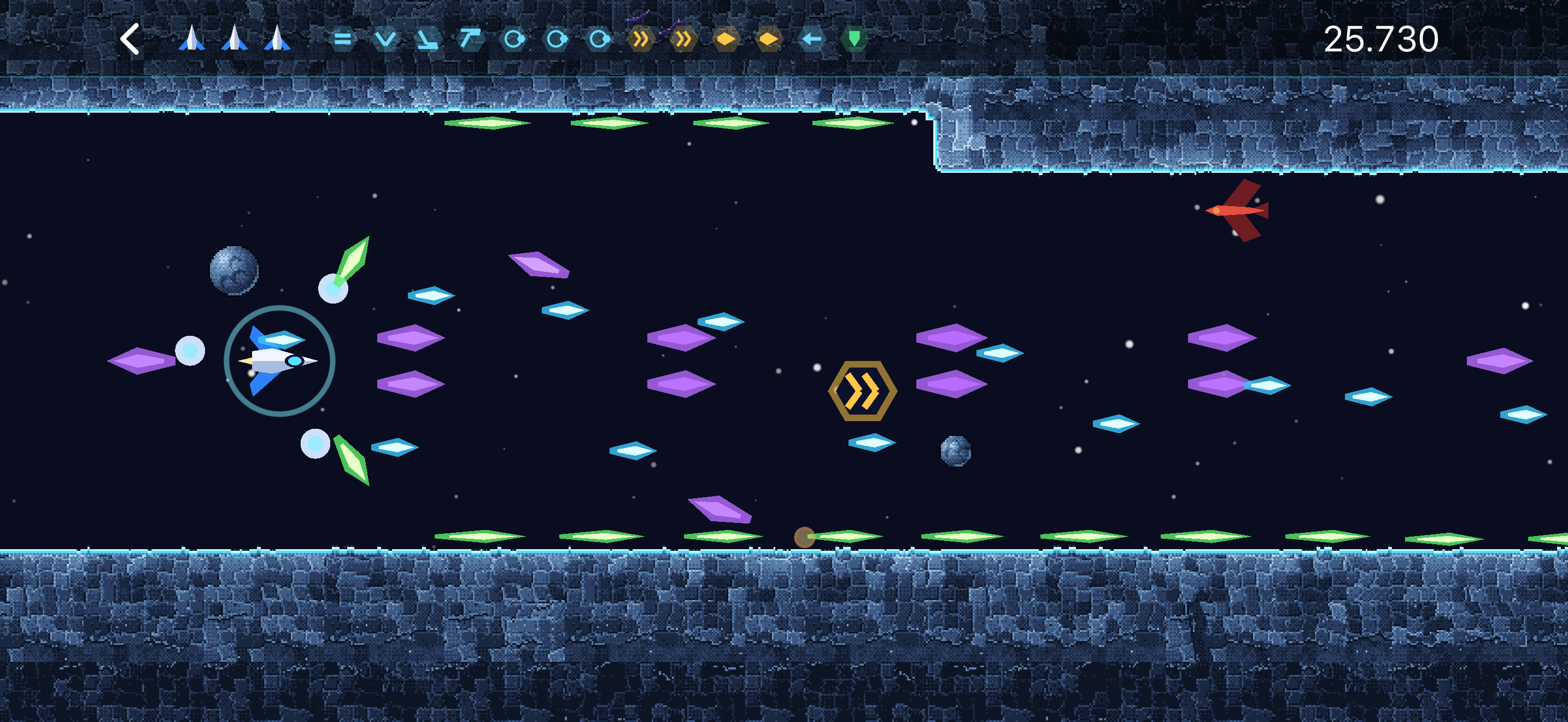
Shoot the right things and you fly on stronger. Pods drift through the corridor carrying eleven different extras, and collecting one changes what your gun is: rapid fire for a shorter interval between shots, power for a heavier bolt, a double or a triple shot, a rear gun firing out of the tail, a laser that makes your bolts bounce off the landscape instead of stopping at it, crawlers that lay a bolt down along the floor or the ceiling, satellites orbiting the ship and firing along with it, a shield that eats the next hit, and a spare ship.
They combine rather than replace each other: the rear gun, the laser, the crawlers and the satellites all pair with whatever pattern you are already firing, so a triple shot that has picked up the laser is three bolts that bounce off the canyon at the angles they arrived. You can read the whole loadout along the top of the screen — green keeps you alive, amber improves the gun you have, ice blue changes what it fires. Lose a ship and the gun goes back to basics: an armament that outlived its ship would make a round easier the longer it went on.
Ten Levels, Ten Bosses
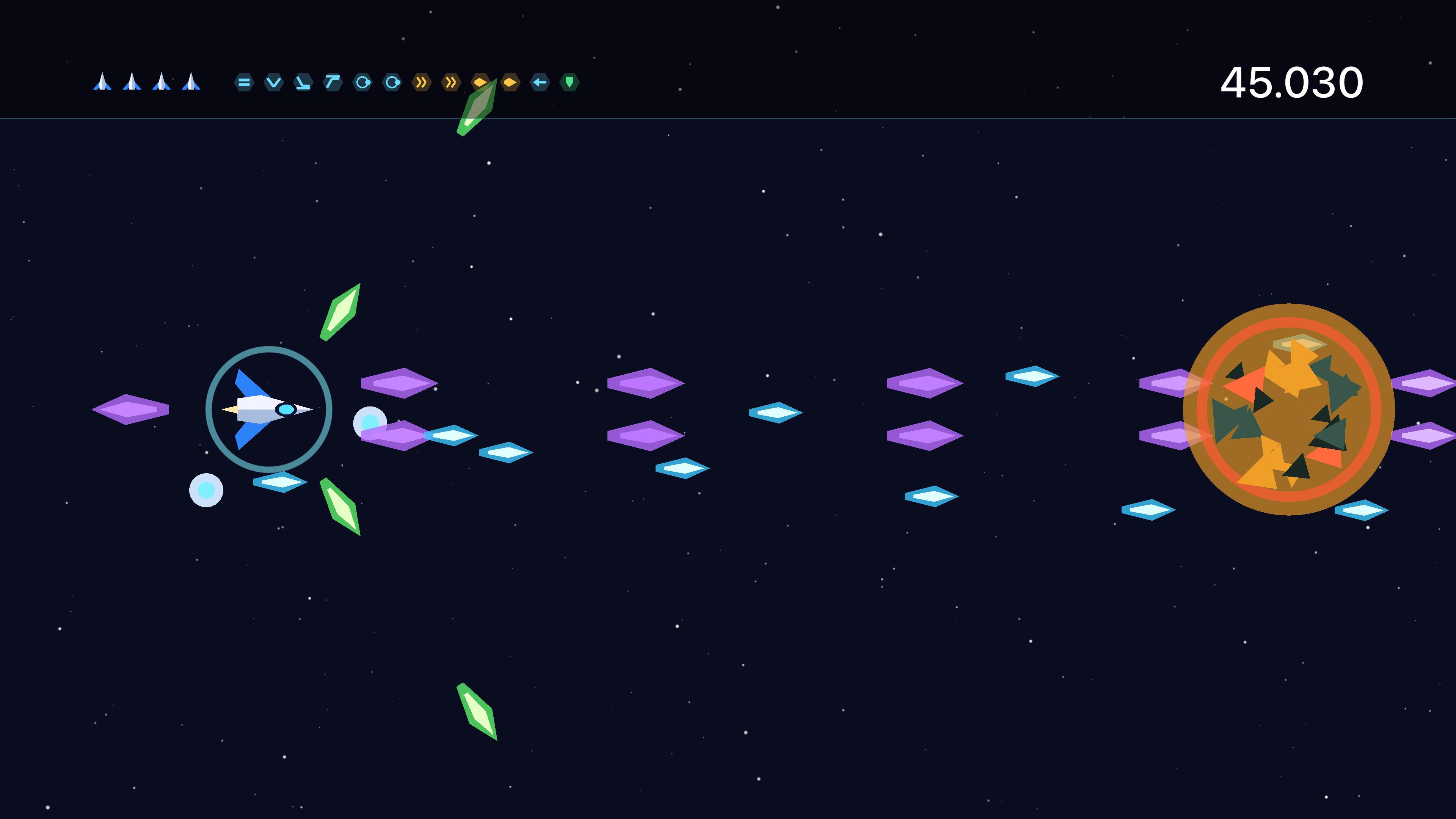
Ten levels, getting quicker as you go: Canyon Run, Iron Pass, Mine Belt, The Gauntlet, Glass Reach, The Hive, The Forge, Salt Drift, The Works and Landfall, each with its own tile set and its own idea of how much room you deserve. Thirteen enemy silhouettes fly eight different paths through them — straight, waves, circles, dives, zigzags, swoops, spirals and hops — alone or in formations of up to eight: a vee, a column, an echelon, a line, a diamond, an arc, a wall, a snake.
Every level ends with a boss. The map runs out, the sky clears for a moment with nothing in it, and a warden comes out of that emptiness. A boss is not a large enemy — it is built of parts. Pods swing on arms, plates sit still and simply soak damage, and some pieces can be shot off while others cannot; a few wardens keep the body untouchable until the destructible parts are gone. Each one fires in a shape of its own — a fan, a ring, a sweep, rain, or alternating volleys — and each one has to be learned before it can be beaten.
And the run does not stop at Landfall. Past the last level the list starts again, still counting up, still paying more: an arcade game ends when the last ship does, not when the author runs out of maps.
Three Settings, One Map
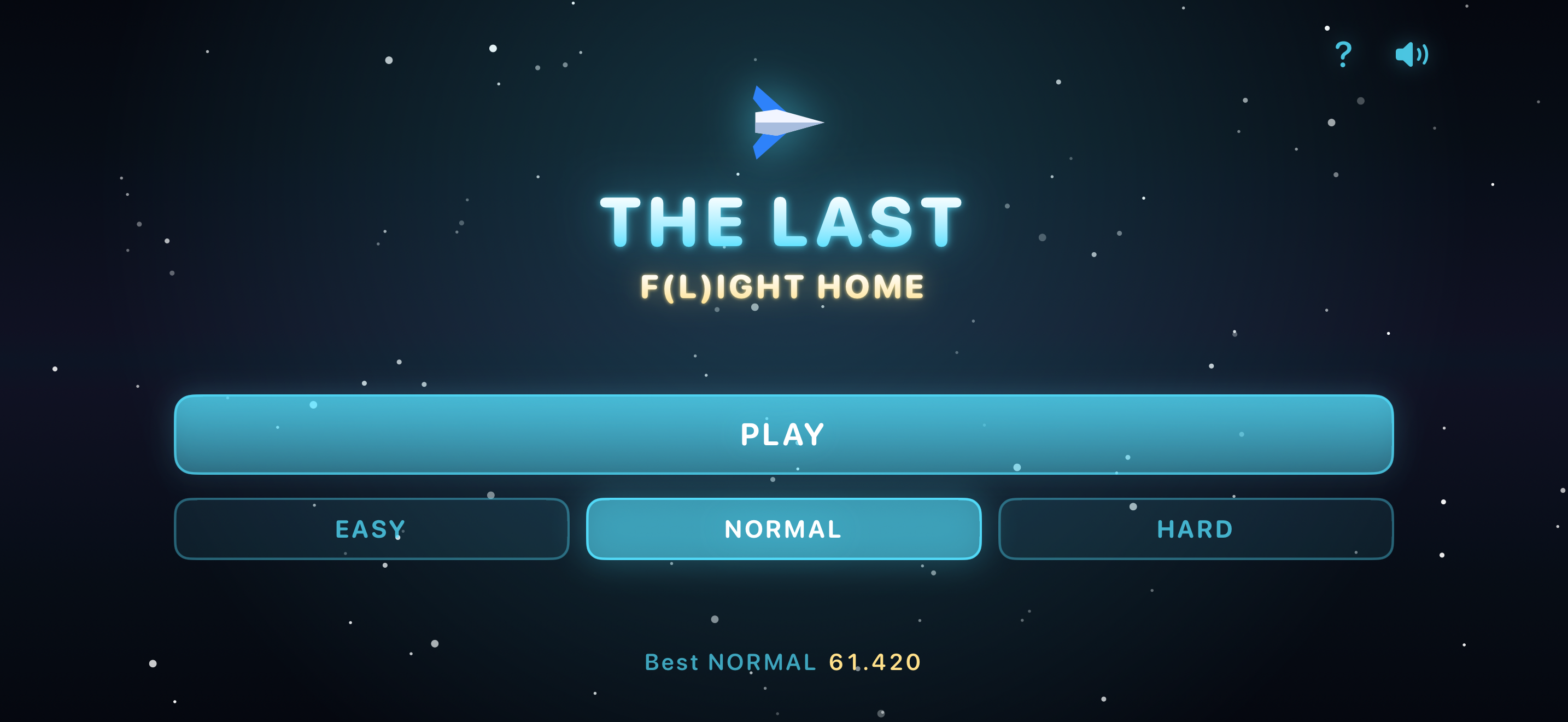
Easy, Normal and Hard are chosen on the start screen and remembered between launches. What changes is the amount of pressure, not the map: enemy bolts fly faster or slower, guns fire more or less often, enemies drift a little quicker — and on Easy anything wearing armour has one plate taken off, though never its last. Where things are stays where things are, because a passage is learned as a place, and stretching that would turn Easy and Hard into two different games.
Each setting keeps its own best score, and each one has its own Game Center leaderboard, so a Hard run is never measured against an Easy one.
On Every Screen You Own
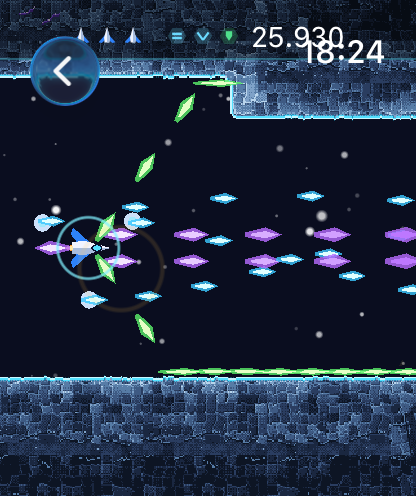
The same game runs on iPhone, iPad, Mac, Apple TV and Apple Watch, and each one steers it the way that platform actually works. On the phone and tablet it is one finger: you drag, the ship follows, and the guns fire themselves. On Apple TV the Siri Remote is a trackpad rather than a stick. Game controllers — DualShock, DualSense, Xbox and MFi — are supported everywhere they connect, as are arrow keys and WASD on a keyboard. On Apple Watch the Digital Crown steers, one notch at a time, and the game hands some time back for it: bolts fly slower, guns fire less often, and the loose hazards — mines and boulders — are left out of the map entirely, because a corridor that is a decision under a thumb would be a coin toss under a Crown.
Thank you for playing! This is the very first release, so development carries on from here — stay tuned for the next updates!

Lite Version
Full Version